

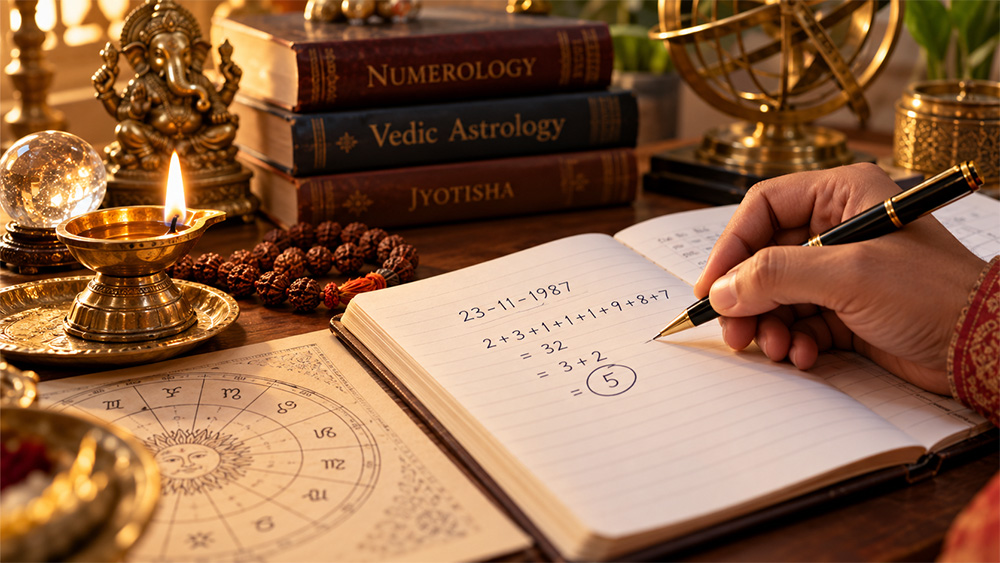
In Ank Jyotish, the Bhagyank is calculated from the complete date of birth. It is commonly used to study the broader pattern or direction of a person’s life.
The Mulank is derived only from the day of birth, while the Bhagyank uses the day, month and year. The two numbers are therefore not interchangeable. A person may have one Graha linked with the Mulank and a very different planetary influence linked with the Bhagyank, and understanding the relationship between them is an important part of Indian numerology.
What Is Bhagyank?
The word Bhagya is commonly associated with fortune, destiny or one’s allotted course. However, the Bhagyank should not be read as a number that mechanically decides whether someone will be fortunate or unfortunate.
A more useful reading is that it indicates recurring themes, tendencies and developmental patterns. Like the Mulank, the final Bhagyank is reduced to a single digit between 1 and 9.
Step-by-Step Method
1. Write your complete date of birth in numerical form, as DD-MM-YYYY.
2. Add every digit.
3. If the total has two digits, add them.
4. Repeat until a single digit remains.
A quick check: the final digit equals the remainder of the total when divided by 9, with a remainder of 0 written as 9.
Worked examples:
| Date of birth | Digit sum | Reduction | Bhagyank | Graha |
|---|---|---|---|---|
| 24-08-1991 | 34 | 3 + 4 = 7 | 7 | Ketu |
| 17-03-1986 | 35 | 3 + 5 = 8 | 8 | Shani |
| 23-09-1985 | 37 | 3 + 7 = 10, then 1 + 0 = 1 | 1 | Surya |
Take 24 August 1991: written numerically it is 24-08-1991, and 2 + 4 + 0 + 8 + 1 + 9 + 9 + 1 = 34. Then 3 + 4 = 7, so the Bhagyank is 7, which is traditionally associated with Ketu.
Take 17 March 1986: 1 + 7 + 0 + 3 + 1 + 9 + 8 + 6 = 35, and 3 + 5 = 8. The Bhagyank is 8, which corresponds to Shani. This does not mean the person is destined for delay or hardship. Shani also represents discipline, structure, endurance, responsibility and gradual achievement.
Bhagyank Numbers and Their Planetary Associations
The standard correspondences are:
| Bhagyank | Graha | Example theme |
|---|---|---|
| 1 | Surya | Individuality, leadership |
| 2 | Chandra | Sensitivity, emotions |
| 3 | Guru | Learning, counsel, growth |
| 4 | Rahu | Ambition, unconventional paths |
| 5 | Budha | Communication, adaptability |
| 6 | Shukra | Relationships, beauty, harmony |
| 7 | Ketu | Introspection, detachment |
| 8 | Shani | Discipline, responsibility |
| 9 | Mangala | Courage, directness, action |
These Grahas provide the symbolic framework through which the number is interpreted. For example, Bhagyank 3 may emphasise learning, counsel, growth and knowledge through Guru. Bhagyank 6 may bring more attention to relationships, beauty, harmony and creativity through Shukra.
Bhagyank vs Mulank: A Worked Example

Suppose a person is born on 23 September 1985.
The Mulank is 2 + 3 = 5, which corresponds to Budha.
The Bhagyank is 2 + 3 + 0 + 9 + 1 + 9 + 8 + 5 = 37. Then 3 + 7 = 10, and 1 + 0 = 1, which corresponds to Surya.
This person carries a Mulank 5 and Bhagyank 1 combination. The interpretation should examine how the adaptable, intellectual qualities of Budha interact with the independent, authoritative qualities of Surya.
Which Number Is More Important?
I do not consider this a useful competition, because the two numbers answer different questions. Mulank is closer to natural temperament and immediate behaviour. Bhagyank reflects the broader pattern through which experience may unfold over time.
One describes how you instinctively move, and the other describes the road on which that movement takes place. Both deserve attention.
Can Bhagyank Predict Your Future?
No. A Bhagyank cannot tell you with certainty that you will become wealthy, marry at a particular age or succeed in a specific profession. Claims of that kind reduce numerology to entertainment.
What the Bhagyank offers is a symbolic framework for observing repeated themes, such as discipline, change, communication, ambition, relationships, introspection or leadership, depending on the number concerned.
How to Use Your Bhagyank in Practice
After calculating your Bhagyank, study the Graha associated with it and then compare its qualities with your Mulank. Ask where the two support each other and where they differ.
A Mulank 2 with Bhagyank 8, for example, combines the sensitivity of Chandra with the discipline of Shani. A Mulank 9 with Bhagyank 5 combines the directness of Mangala with the adaptability of Budha. Such combinations are far more informative than studying one number alone.
The purpose of the Bhagyank is not to hand over your responsibility to destiny. It helps you understand certain rhythms of life with more clarity, so that you can decide consciously how to respond to them.
For a complete interpretation of your Bhagyank in relation to your other numbers, please contact me, Vedant Kulkarni.