
Three paths. A shared purpose.
Vedic astrology encompasses several traditions, each offering a different approach to understanding life's questions. At Trusted Astrology, we introduce three distinctive disciplines.

Prashna Shastra, astrology of the question
Prashna Shastra is a branch of Jyotish that interprets a chart calculated for the moment a meaningful question is asked.
It is traditionally used to explore specific situations, decisions, and uncertainties, even when complete birth information is unavailable.
Pandit Parashar Sharma
Prashna ShastraOver Four Decades Devoted to the Art of Jyotish and Prashna Shastra!
Born in Varanasi into a family of pandits where Jyotish has been passed down from father to son, Parashar Sharma learnt to read the Panchang even before he learnt to write. His father taught him planetary calculations and the principles of Brihat Parashara Hora Shastra from childhood itself.
He further deepened his learning in Kashi and then in Ujjain, under the guidance of renowned masters. A holder of the title of Jyotish Acharya, he has dedicated his entire life to the study of the Grahas, Bhavas and Lagna, as well as the traditional methods of consultation handed down by his gurus.
For more than forty years, he has been receiving people who come seeking greater clarity in times of doubt, transition or decision.
His area of specialisation is Prashna Shastra, the art of studying a specific question from the exact moment at which it is asked.
When a person consults him, Panditji does not try to narrate a fixed future. He prepares the Prashna Kundli and studies the Prashna Lagna, the Bhava related to the question and its lord, the position of Chandra, the Drishtis and the relationships among the various Grahas.
Every indication is cross-checked against the others.
It is this rigorous method that enables him to address concrete concerns: career choices, relationships, projects, travel, disputes, opportunities or periods of change, among others.
His approach rests on a simple conviction: the planets do not decide on your behalf; they reveal tendencies which one must learn to understand.
This is precisely what people approaching him are looking for: not some spectacular promise, but a clear and structured perspective on a situation that has become difficult to judge on one’s own.
A consultation can thus help you to step back, identify the strengths and obstacles at play, understand why a situation seems stuck, and approach your decisions with greater viveka, or discernment.
Parashar Sharma is known for his calm, his attentiveness and his refusal to jump to hasty conclusions. Before every consultation, he observes a few moments of silence, fixes the exact moment of the question with precision, and only then begins his study.
After several decades of practice, his aim remains the same: to help you see more clearly where doubt has taken up too much space.
Consult Pandit Parashar Sharma for a Prashna Shastra Study
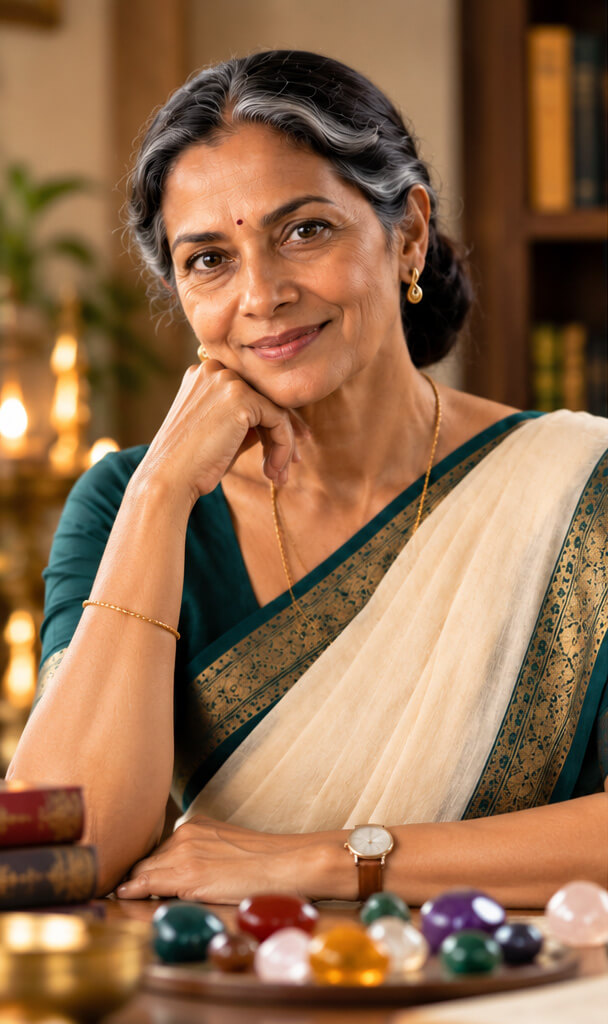
Ratna Shastra, the tradition of gemstones
Ratna Shastra explores the traditional relationships between gemstones and planetary influences.
In Jyotish, gemstones are associated with the Navagraha, and their selection is traditionally considered in relation to an individual’s birth chart.
Devika Mehta
Ratna ShastraA Life Devoted to Gemstones and Jyotish, and to the Art of Choosing the Right Gem at the Right Time!
Born in Jaipur, one of the world’s great capitals of the gemstone trade, Devika Mehta grew up in a world where gemstones were a part of everyday life.
Her father was a gemologist. Her mother practised Vedic astrology.
From a very young age, she learnt to tell the difference between rubies, sapphires, emeralds, corals and other precious stones. But she also understood that a gem is not judged only by its beauty, rarity or value.
In the tradition of Ratna Shastra, certain gemstones are matched with the Navagraha, the nine planetary influences of Jyotish.
It is this dual knowledge that makes Devika Mehta unique today.
She went on to deepen her study of Ratna Shastra in order to understand precisely the traditional links between the Grahas and certain gemstones. Since then, she has been guiding people who wish to know which stone is truly suited to their horoscope.
For Devika, a recommendation never begins with a stone. It begins with your Kundli.
She studies the Lagna, the Bhavas, their lords, the Drishtis and, above all, the condition of the various Grahas. Her aim is to determine which planetary influence deserves to be supported, and which gemstone may, as per tradition, be recommended on that basis.
This caution is essential. A stone traditionally associated with Surya, Chandra, Guru, Shukra or Shani should not be chosen merely because it is reputed to be favourable.
The right gem is the one that matches your personal planetary configuration. She therefore also advises on the choice of the right time, the muhurta: day, hour, nakshatra and, above all, the energisation of the stone (pran pratishtha, mantra, jaap) before it is worn. She also determines with precision the finger, the metal (gold, silver, panchdhatu, ashtadhatu) and the hand, if you wish to wear the stone as a ring.
This is why Devika refuses ready-made recommendations of the “your Rashi, your stone” type, which ignore the rest of the horoscope.
Her knowledge of gemstones then allows her to go further: quality, colour, transparency, visible flaws, the nature of the gemstone and the overall consistency of the recommendation are examined with great rigour.
Approaching Devika Mehta means looking for much more than a mere “lucky charm”. It is to receive a personalised reading aimed at identifying the stone which, within the traditional framework of Ratna Shastra, can support certain qualities you wish to strengthen in your life: confidence, stability, clarity, harmony, determination or the capacity to evolve.
Her rule is simple: a magnificent stone that is wrongly chosen is not a good recommendation.
Discover the Gemstone Recommended by Devika Mehta

Anka Shastra, Indian numerology
Anka Shastra explores the symbolic significance of numbers and their traditional associations with planetary influences.
It examines elements such as birth numbers, destiny numbers, and name numbers to explore patterns and personal characteristics.
Vedant Kulkarni
Anka ShastraReading Numbers with Rigour to Better Understand the Rhythms of a Life.
Born in Nashik into a family of Sanskrit professors, Vedant Kulkarni grew up amidst ancient texts, Indian philosophy and a culture in which the transmission of knowledge held a central place.
At a very young age, he discovered in his grandfather’s library an ancient manuscript on Anka Shastra, the numerological tradition. This discovery has shaped the course of his life ever since.
He devoted years of intensive study to Sanskrit, immersing himself in the numerical traditions found in classical texts — their symbolism, their transmission and their place in scholarly thought.
Unlike the simplified approaches so widespread today, Vedant refuses quick interpretations based on a single number. For him, a number has meaning only when seen as part of a whole.
He studies in particular the fundamental numbers derived from the date of birth, such as Mulank and Bhagyank, and then examines their relationships, their possible tensions and the qualities traditionally associated with the corresponding Grahas.
His work rests on a precise method: comparing the principles handed down by the texts, weighing different interpretations against one another, and observing their consistency across the many cases studied over the years.
Vedant does not seek to confine you within a definition. He seeks, instead, to bring out the rhythms that keep recurring in your journey, the dispositions that seem natural to you, the periods that demand greater effort and the moments when certain decisions can be approached with more discernment.
This is what makes his approach particularly useful when you are going through a phase of doubt, a change of direction or personal questioning.
Some people understand very well what they are going through, yet cannot make out why the same patterns keep repeating. Others are torn between several directions and feel the need for a different framework to analyse their choices. Anka Shastra can then become a complementary tool for understanding.
Vedant works slowly and with care. He never meets a large number of people on the same day, preferring to devote time to each study and to verify the relationships between the different numbers before offering an interpretation.
His aim is not to announce a fixed future to you. It is to help you better understand your tendencies, your cycles and your points of support, so that you can move forward with greater clarity, consistency and discernment.
Numbers do not decide for you. They can, however, reveal with clarity the structure of certain rhythms that you had not yet identified.
Discover Your Anka Shastra Study with Vedant Kulkarni
Astrology is a traditional interpretive practice, not a science: our specialists offer perspectives to reflect on, never guaranteed outcomes. Your choices remain yours.