


The Mulank is one of the first numbers studied in Indian numerology. It is simple to calculate, because it depends only on the day of the month on which you were born. Your birth month and year are not used.
Once the method is understood correctly, it becomes a good starting point for studying the symbolic relationship between numbers and the Navagrahas.
What Is Mulank?
Mulank may be translated as the “root number”. In common Ank Jyotish practice, every birth day is reduced to a single digit between 1 and 9.
Step-by-Step Method
1. Take only the day of the month on which you were born.
2. If it is a single digit, that digit is your Mulank.
3. If it has two digits, add them.
4. If the sum still has two digits, add again until one digit remains.
Some examples:
| Birth day | Working | Mulank |
|---|---|---|
| 3rd | 3 | 3 |
| 14th | 1 + 4 = 5 | 5 |
| 21st | 2 + 1 = 3 | 3 |
| 28th | 2 + 8 = 10, then 1 + 0 = 1 | 1 |
| 29th | 2 + 9 = 11, then 1 + 1 = 2 | 2 |
Note that the 19th, 28th and 29th need two rounds of addition. People born on the 3rd, 12th, 21st and 30th of any month all have Mulank 3. The result does not change with the month or the year.
Mulank Numbers and Their Grahas
The nine Mulanks are traditionally associated with nine planetary influences. The table below also gives all the birth dates for each Mulank.
| Mulank | Birth dates | Graha |
|---|---|---|
| 1 | 1, 10, 19, 28 | Surya |
| 2 | 2, 11, 20, 29 | Chandra |
| 3 | 3, 12, 21, 30 | Guru |
| 4 | 4, 13, 22, 31 | Rahu |
| 5 | 5, 14, 23 | Budha |
| 6 | 6, 15, 24 | Shukra |
| 7 | 7, 16, 25 | Ketu |
| 8 | 8, 17, 26 | Shani |
| 9 | 9, 18, 27 | Mangala |
The pattern follows from simple arithmetic. A number and its digit sum always differ by a multiple of 9, so dates that are 9 apart reduce to the same single digit. This is why each row of the table moves in steps of 9, and why two people born in different months can share the same Mulank.
What Does Your Mulank Represent?
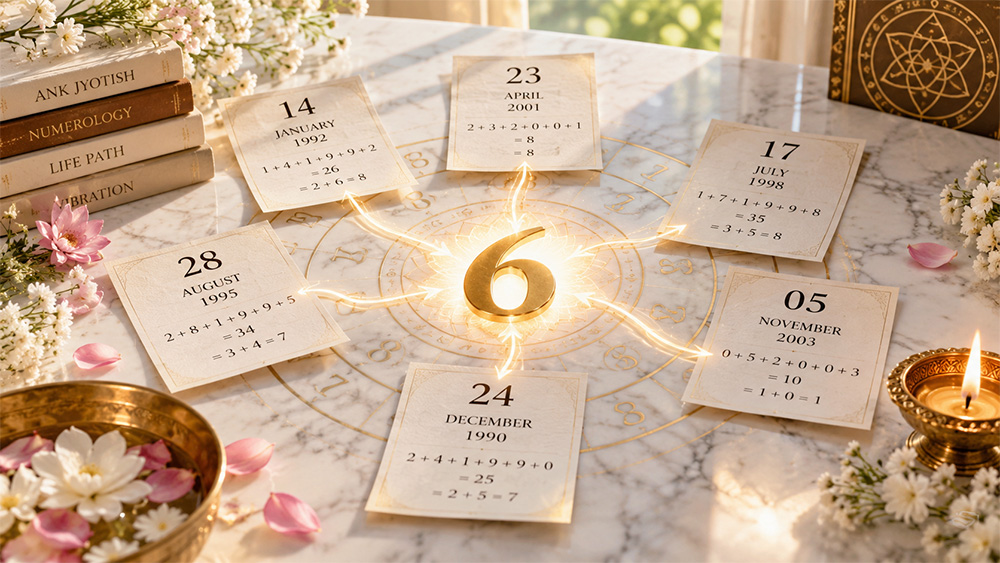
The Mulank is generally used to study the more immediate layer of personality. It indicates how a person naturally expresses themselves, approaches challenges, makes decisions and responds to their surroundings.
For example, Mulank 5 is connected with Budha, which symbolically relates to communication, intelligence, adaptability and learning. Mulank 8 corresponds to Shani and is associated with discipline, patience, responsibility and long-term effort. These qualities describe tendencies and are not fixed outcomes.
A person may have a Mulank associated with initiative and a Bhagyank connected with patience and restraint. This is not a contradiction. Human character is rarely described adequately by a single number.
Mulank and Bhagyank Are Different Quantities
The Mulank uses only the birth day. The Bhagyank uses the complete date of birth, including the day, month and year.
Take a person born on 14 July 1992. The Mulank is calculated from 14 alone: 1 + 4 = 5.
The Bhagyank needs all the digits of 14-07-1992: 1 + 4 + 0 + 7 + 1 + 9 + 9 + 2 = 33, and then 3 + 3 = 6.
This person therefore has Mulank 5 (Budha) and Bhagyank 6 (Shukra). The two numbers describe different symbolic dimensions.
How Should You Interpret Your Mulank?
Do not begin by asking whether your Mulank is “lucky” or “unlucky”. No number is universally fortunate or unfortunate. Each Graha has both constructive qualities and challenges. Surya can indicate confidence and also excessive pride. Budha can indicate intelligence and also restlessness. Shani can show discipline and also delay.
A mature reading considers both sides. Treat your Mulank as a starting hypothesis for self-observation: calculate it correctly, read the qualities of its Graha, and then compare them with what you actually see in your own behaviour. That approach is far more informative than letting a single number define your life.
If you would like your Mulank and Bhagyank read together, please contact me, Vedant Kulkarni, and I will go through both numbers with you.