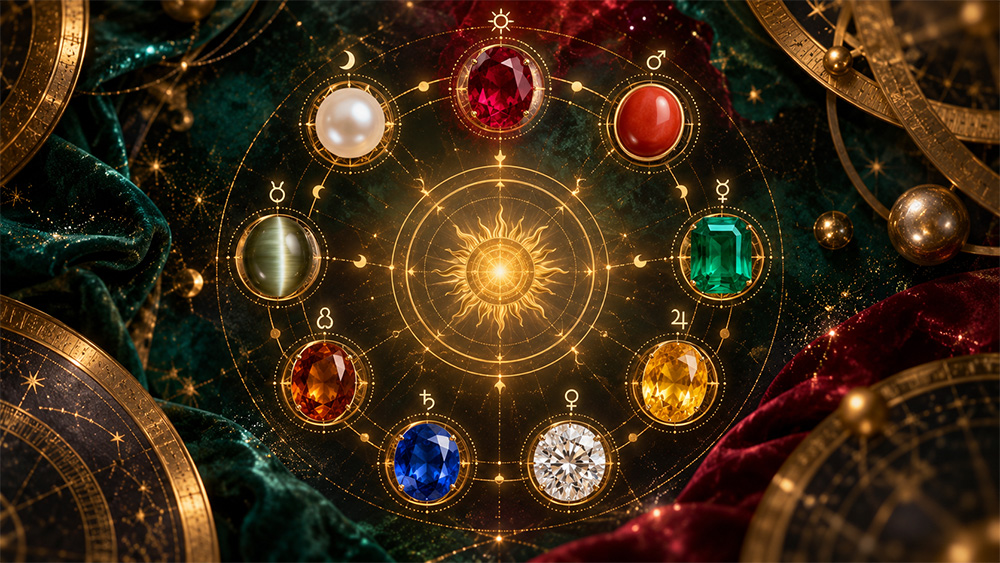
Navaratna means “nine gems”. These nine gemstones match the Navagrahas, the nine planetary influences of Jyotish.
Navaratna rings and pendants are a familiar sight in many of our homes, from grandmothers’ jewellery boxes to wedding sets and temple ornaments. But a Navaratna is not just pretty. Each Ratna stands for one planet and the qualities linked with it, and knowing these nine matches is the foundation of Ratna Shastra. So let’s meet them one by one!
1. Ruby — Surya
Ruby, or Manik, belongs to Surya, the Sun. Surya stands for vitality, identity, authority, dignity and personal radiance. A fine ruby has a strong red colour, good transparency and plenty of brilliance.
Gemmologically, ruby is the red variety of corundum, and it is one of the hardest natural gemstones around.
2. Pearl — Chandra
Pearl, or Moti, goes with Chandra, the Moon, which stands for the mind, emotions, memory and sensitivity.
Unlike mineral gemstones, natural and cultured pearls are organic and are made by molluscs. Their quality is judged by lustre, surface, shape, colour and nacre.
3. Red Coral — Mangala
Moonga, or red coral, belongs to Mangala, Mars, the planet of courage, initiative, determination and action.
Coral is organic and not crystalline. Good red coral has an even, attractive colour and a well-polished surface.
4. Emerald — Budha
Emerald, or Panna, represents Budha, Mercury: intellect, communication, learning, logic and business.
It belongs to the beryl family. Natural emeralds almost always have some inclusions, so do not expect a perfectly clear stone.
5. Yellow Sapphire — Guru
Yellow sapphire, popularly known as Pukhraj, belongs to Guru or Brihaspati. Guru stands for wisdom, knowledge, teachers, philosophy and expansion.
Like ruby and blue sapphire, it is a corundum. Colour, transparency, treatment and origin can change its value a lot.
6. Diamond — Shukra
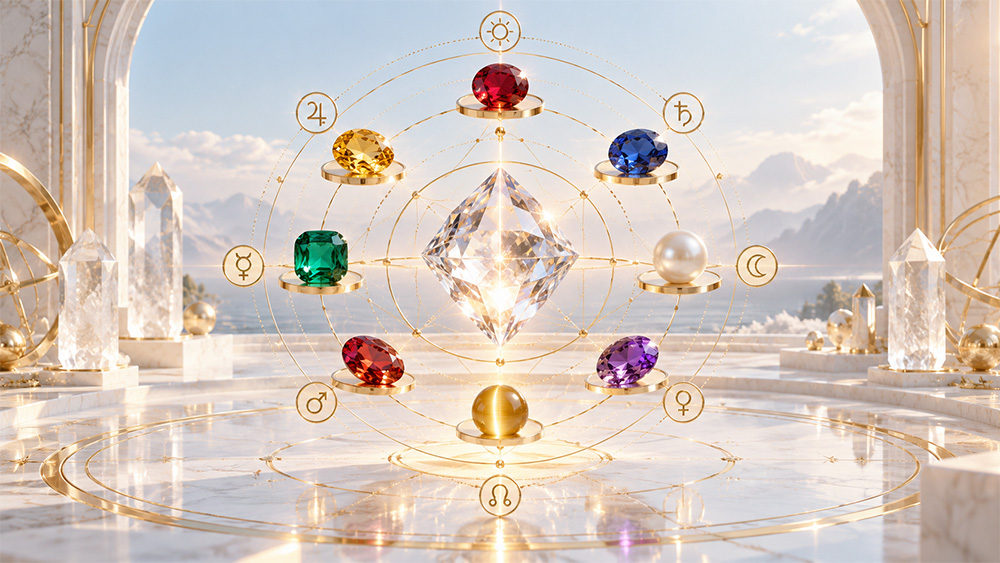
Diamond belongs to Shukra, Venus, the planet of beauty, harmony, relationships, the arts and refinement.
Gemmologists grade diamonds on the famous four Cs: cut, colour, clarity and carat weight. For astrological use, however, your Kundli matters more than the commercial grade alone.
7. Blue Sapphire — Shani
Blue sapphire, or Neelam, corresponds to Shani, Saturn: discipline, responsibility, patience, endurance and time.
This is one stone for which I always urge caution. It is gorgeous, but please never wear it before checking Shani’s role in your Kundli.
8. Hessonite — Rahu
Gomed, which is hessonite garnet, goes with Rahu, the north lunar node. Rahu is linked with ambition, unconventional experiences, strong desire and transformation.
Hessonite usually shows warm honey, orange-brown or reddish-brown tones.
9. Cat’s Eye — Ketu
Cat’s Eye, often called Lehsunia, corresponds to Ketu, the south lunar node. Ketu is associated with detachment, introspection, spirituality and loosening of worldly attachments.
The glowing line you see on a fine cat’s eye is called chatoyancy, and it is what makes the stone so special.
Should Everyone Wear Navaratna?
Not necessarily. A Navaratna piece stands for all nine planets, but that does not mean every person needs all nine strengthened equally. A personal prescription should be based on your Lagna, houses, planetary lordships, dignity, Dashas and the complete Kundli.
That is why I separate two things: admiring Navaratna as traditional jewellery, and prescribing a Ratna for astrological purposes. They are related, but they are not the same.
In Ratna Shastra, precision matters. A stone should never be chosen only because it is beautiful, famous or costly. The right Ratna is the one that is gemmologically sound and astrologically suitable.
Wondering which of the nine is meant for you? Write to me, Devika Mehta, and we will find out together.