

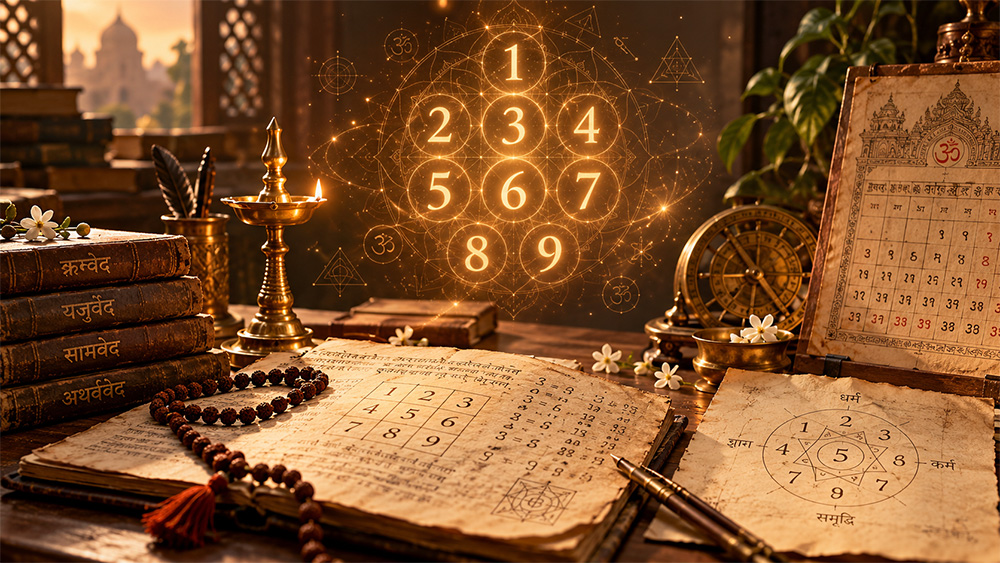
Numbers are normally treated as tools of calculation. In Ank Jyotish they are also studied as symbolic indicators of temperament, tendencies and recurring patterns in a life.
Ank Jyotish, also called Indian numerology or Ank Shastra, works with numbers derived mainly from a person’s date of birth and name. The two most commonly used are the Mulank, derived from the day of birth, and the Bhagyank, derived from the complete date of birth.
It is a symbolic system and not an experimental science. Its results are best treated as a framework that you can test against your own observations.
Definition and Scope
Ank means “number”, and Jyotish refers to the traditional Indian discipline concerned with time, celestial patterns and their interpretation. Ank Jyotish is therefore a rule-based system. It assigns the digits 1 to 9 to the nine Grahas and then reads personality and timing through these assignments.
The Number–Graha Mapping
The standard mapping used in popular Indian numerology is given below.
| Number | Graha | Qualities traditionally associated |
|---|---|---|
| 1 | Surya | Individuality, authority, vitality |
| 2 | Chandra | Mind, emotions, sensitivity |
| 3 | Guru | Knowledge, wisdom, guidance |
| 4 | Rahu | Ambition, unconventional experience |
| 5 | Budha | Communication, adaptability, intellect |
| 6 | Shukra | Harmony, relationships, creativity |
| 7 | Ketu | Introspection, detachment |
| 8 | Shani | Discipline, responsibility, endurance |
| 9 | Mangala | Courage, initiative, action |
For example, number 1 is linked with individuality and authority through Surya, while number 5 is linked with communication, adaptability and intellect through Budha.
Mulank: The Root Number

The Mulank, also called the birth number, is derived from the day of the month on which a person was born. The digits of the day are added until a single digit remains.
For someone born on the 14th: 1 + 4 = 5. The Mulank is 5.
All people born on the 5th, 14th or 23rd of any month share Mulank 5. In traditional interpretation, the Mulank is used to study basic temperament, instinctive responses and the way a person naturally approaches situations.
Bhagyank: The Destiny Number
The Bhagyank is calculated from the complete date of birth. For a person born on 24 August 1991:
2 + 4 + 0 + 8 + 1 + 9 + 9 + 1 = 34
3 + 4 = 7
The Bhagyank is 7.
Mulank describes the more immediate personality tendencies, while Bhagyank is used to study the broader direction or rhythm of a life. The two should be read together.
A useful mathematical note: this repeated addition of digits gives the digital root of the number. It is equal to the remainder after division by 9, with a remainder of 0 written as 9. You can use this to check your own calculations quickly.
Namank: The Name Number
Another widely used method assigns a numerical value to the letters of a person’s name. This is called Namank.
Different numerological systems use different letter tables. A result can be reproduced only if the table is stated, so the method used must always be specified. This matters most in name correction, business names and baby names.
Changing the spelling of a name only to obtain an attractive number, without understanding the method behind it, is not serious numerological practice.
What Can Ank Jyotish Be Used For?
Ank Jyotish is commonly applied to:
✦ personality analysis;
✦ relationship compatibility;
✦ career tendencies;
✦ business names;
✦ important dates;
✦ house numbers;
✦ vehicle numbers;
✦ mobile numbers;
✦ personal cycles.
Its value is highest when numbers are read as patterns and are not treated as promises.
Is Numerology the Same as Astrology?
No. A complete Jyotish Kundli uses the positions of Grahas, Rashis, Bhavas, Nakshatras and other astronomical factors, all calculated from the time and place of birth. Ank Jyotish works mainly with numerical patterns derived from the date of birth and the name.
The two systems can complement each other, but their inputs and methods are different.
A Systematic Way to Use Ank Jyotish
I recommend a simple procedure, which keeps the exercise honest:
1. Calculate your Mulank and Bhagyank carefully.
2. Note the qualities of the Grahas linked with them.
3. Compare these qualities with your actual decisions, relationships and habits over a period of time. A short written record helps.
4. Record both the matches and the mismatches. Both are useful data.
A number is not a limitation. If your Mulank is connected with Shani, for example, it does not mean your life must be difficult. It points to themes such as patience, discipline, responsibility and gradual achievement.
Numbers do not remove free will. They give us a language with which we can examine certain rhythms of life with more attention.
For a detailed analysis of your own numbers, you may contact me, Vedant Kulkarni, and I will walk you through the calculations and their interpretation.